Overview
The Olhe.ai ecosystem is a milestone in physical security and access management. In high-traffic environments, traditional security based on turnstiles and human surveillance becomes flawed and costly. Olhe.ai solves this bottleneck through distributed facial biometrics.
The system was built on a highly optimized Deep Learning architecture, capable of identifying faces with extreme precision in milliseconds, regardless of lighting conditions — and linking this to a robust business rules engine that now goes beyond identification: it understands behavior and flags what falls outside the norm.
Key Features
- Scalable Facial Recognition: Live face detection and identification through camera streams (RTSP/ONVIF). Unlike single turnstiles, the system can validate multiple people simultaneously in the same frame.
- Individual Tracking: Once a subject enters the monitored environment, tracking algorithms follow their trajectory across different cameras, understanding movement flow and dwell time.
- Frictionless Time-Clock System: Used as a corporate HR tool, employees clock in simply by walking towards the camera — eliminating queues and ensuring an extremely secure, fraud-proof touchless experience.
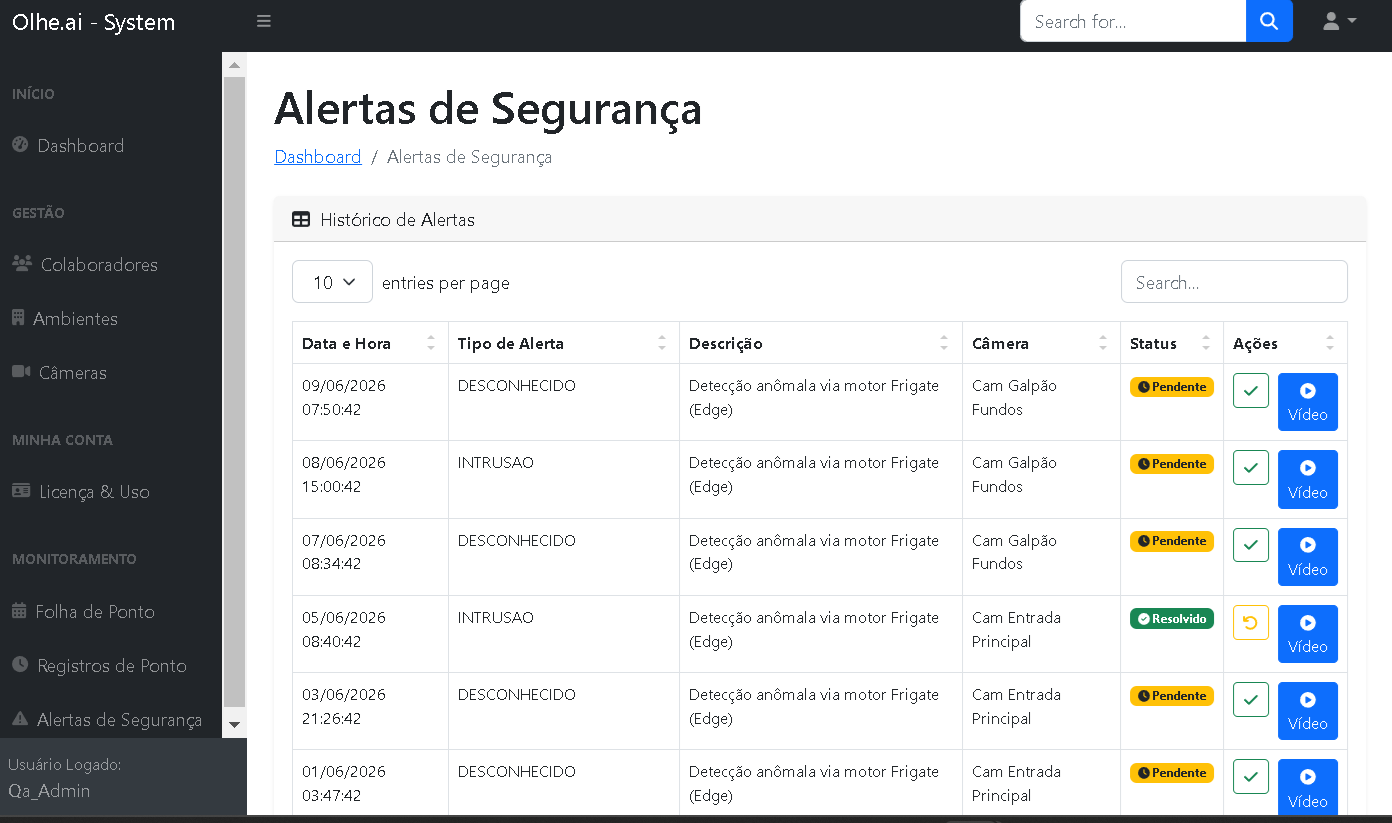
- Smart Security Alerts: Blacklist registration allows flagging unauthorized or restricted individuals. When a match is detected in the video feed, administrators receive an immediate alert in the management view, enabling proactive security response.
Real-Time Alerts & Anomaly Detection
The platform now goes beyond recognition — it understands context. Two new intelligence layers have been added to turn passive surveillance into an active security system.
Instant Alert Engine
Every recognition event is evaluated in real time against a configurable rule set. When a flagged individual is detected, a blacklisted face appears in a restricted zone, or an access attempt fails repeatedly, the system fires an immediate alert — pushed to the security dashboard, to a designated operator, or to an external channel. No delay, no manual monitoring required.
Behavioral Anomaly Detection
Beyond identifying who is present, Olhe.ai now models what normal looks like. Using historical flow data — typical entry times, usual trajectories, expected dwell durations — the system automatically flags deviations: someone lingering in a restricted area far longer than average, an unusual access pattern outside business hours, or a crowd density spike in a monitored zone. These anomalies are surfaced to operators before they escalate into incidents.